Hi! Could you tell us about the very beginning of your career? Why did you decide to start releasing music? How did Touched come up with the idea of helping people with cancer?
Hi! Great to meet you, and thanks for your interest in Touched!
I came up with the idea after my mother was diagnosed with cancer in 2013. The Macmillan nurses were so kind and provided such great care for her that I wanted to give something back. I just had the idea one afternoon at work. I can still remember it. I thought about making a small compilation album, asking a few label mates and some friends I talked to online about music. I also approached a few artists whose music I liked.
So I put out some feelers about the idea, and it was great. Lots of people were into it. I thought that if we made £500, that would have been amazing.
So I set up the Facebook and Twitter pages, and my friend Tom Roberts made the website. It was all set, so I just started emailing artists and asking them about it.
Touched One had over 120 artists on it. It raised over £2,000 in the first few months. I knew we were onto something.
I don’t just pick artists randomly. They are artists I’ve been into for a number of years, or I can hear one track on SoundCloud that stands out and ask them if they want to be part of Touched. I’m into so many great artists that the albums are now getting bigger and bigger. On Touched 3, lots of artists came to me and said they wanted to be part of it and help out. Also, getting it to reach as many people as possible is important. It’s better to have 400 artists talking about it than just a few.
It’s the final mega compilation, but it’s not the end of Touched. I already have the next five releases planned out.
Tell us more about Macmillan Cancer Support.
Macmillan Cancer Support is one of the largest British charities and provides specialist healthcare, information, and financial support to people affected by cancer.
As well as helping with the medical needs of people affected by cancer, Macmillan also looks at the social, emotional, and practical impact cancer can have, and campaigns for better cancer care. Macmillan Cancer Support’s goal is to reach and improve the lives of everyone living with cancer in the UK.
The charity was founded as the Society for the Prevention and Relief of Cancer in 1911 by Douglas Macmillan following the death of his father from the disease. In 1924, the name was changed to the National Society for Cancer Relief, which it retained until 1989, when it was changed to Cancer Relief Macmillan Fund, later changed again to Macmillan Cancer Relief. On April 5, 2006, Macmillan Cancer Relief became known as Macmillan Cancer Support, as this more accurately reflected its role in supporting people living with cancer. It adopted the principles of being a “source of support” and a “force for change.”
Autechre, Luke Vibert, Ochre, Arovane, µ-Ziq, Richard Devine… that’s an incomplete list of the musicians who have appeared on your compilations. How did you manage to receive such support from them? How did it all come about?
Asking the artists has been both one of the best parts and the hardest part of running Touched. The good bits are when you email one of your musical heroes and they say something like, “Oh great, I’ve been waiting for you Touched guys to ask me to be part of something for a long time. I’ve been really into the idea since I heard about it.”
To be honest, most of the artists I’ve asked have been into the idea. Some say, “Ask me again when you do the next one, as we have nothing at the moment,” and I understand that. A few have just said no, and that does put you off them and their music, but that can’t be helped. So I worry when I ask some of my long-time favourites. Luckily, most say yes.
The hardest album to date to put together, I think, was Touched 2 Remixes, as I was not just talking to one artist about a track. Two people had to be happy with the outcome of the remix.
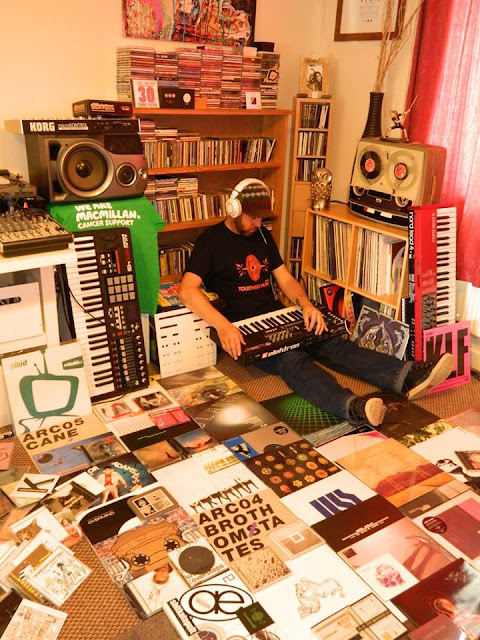
Martin Boulton
Is the label open to giving young musicians an opportunity to release their music?
Touched is all about the quality of the music, so whether you’re young or old, it really doesn’t matter to me. I know that Touched has been a place where lots of first-time producers have released music, and doing it alongside some of the big names in music is a great feeling. Being on the same album as Autechre or The Future Sound of London, when is that ever going to happen to most people?
What has changed in the British electronic music scene since the emergence of IDM?
When I first started listening to electronic music, it was just called dance music. I was into the likes of Orbital, The Future Sound of London, 808 State, Underworld, and The Chemical Brothers. Then I started getting into the more experimental side of things with Aphex Twin and The Sabres of Paradise.
By 1996, I was into the likes of Autechre, The Black Dog, and B12. By then, I was calling it electronica. I think the whole IDM name came in around the 2000s, with labels like Worm Interface, Toytronic, Ai Records, and Merck. I was getting into artists like Arovane, Proem, Abfahrt Hinwil, Brothomstates, Kettel, Funckarma, and Datassette, just to name a few that come to mind.
I find nowadays that most people who enjoy IDM want to make it, and it’s never been easier to get your hands on some software and start experimenting. With so much of it, you have to look hard to find the gold, but it is out there. The thing I have found is that now, in 2016, there aren’t that many labels for IDM artists who are starting out. So most start off with netlabels, and they never seem to get that much of a following. Some of the artists I’ve released on Touched could really do with a nice label to release their music on CD and vinyl, but they are hard to come by.
I think the biggest thing that has killed people’s interest in buying music is YouTube. If you want to hear any track, most of the time you can find it there, maybe not so much underground IDM music, but most of the bigger-label stuff.
The only good thing about it all is that most artists have to go out and play live now to make that extra bit of money after poor record sales. But it’s great for the fans, as you can get to see artists who would mostly never leave their bedrooms.
I really didn’t think that Touched would have been the ride of my life that it has been. Talking to all the artists that I’ve really looked up to and listened to for many years, having lots of them do remixes, and working with all the artists on the album covers has been a joy. It’s just been a dream come true, and now, almost hitting £50,000, it’s just so mind-blowing.
Lots of people think that Touched is a massive team of people working for Macmillan, but it’s just me, my love for music, and my mother making all this happen.
What does Touched do besides releasing music? Does it organize events or anything of the kind?
In 2015, Touched did its first live event in an old cinema in South Wales. It had a great lineup, and we used the cinema’s big screen for the visuals. It looked and sounded amazing. People came from other countries just to see what we were doing. It was great.
A few people have asked me about doing another Touched live event, and it’s something that I’ve not ruled out yet. Let’s see what happens in 2017.
I’ve been asked to DJ at this year’s 21rpm all-day music festival in Soho, London, on October 1. Lots of artists who have been on Touched will be performing, like Seefeel, Plaid, Luke Vibert, Funkstrong, and Graham from 808 State, among many others.
Questions: Ilya Kudrin